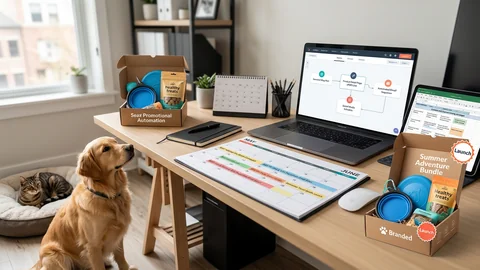
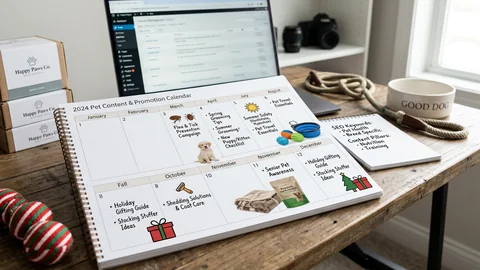
Automated Editorial Calendars for Pet Brands: Seasonal and SKU-Aware


Table of Contents +
- The specific problem: cadence collapses when seasons and stock shift
- Scenario focus: aligning flea/tick season with in-stock preventatives
- Quick decision guide
- How to implement an automated, SKU-aware seasonal calendar
- Monitoring: what to check after 7-14 days and 4-8 weeks
- Practical safety boundaries
- Evidence status and what the data suggests
- Measurement blueprint for SKU-season alignment
- Frequently Asked Questions
- Conclusion and next steps
- References
Plan pet content to match seasons and stock. Align fleas, shedding, travel spikes with SKUs via automated calendars for steadier traffic and revenue.
Seasonal demand moves fast in pet care. Fleas do not wait for your content calendar. Neither do shedding cycles or travel surges. Your cadence must adapt automatically.
This matters because publishing the right article at the wrong time loses intent and revenue. You will learn how an automated, SKU-aware calendar maintains weekly momentum, maps posts to in-stock products, and protects trust when seasons and stock shift.
The specific problem: cadence collapses when seasons and stock shift
Why manual calendars miss fleas, shedding, and travel windows
Manual planning struggles to react when search interest spikes early after a warm spell, or drops after a cold snap. Seasonal pet content planning needs data feeds, not guesswork. Without automation, weekly cadence slips and opportunity decays rapidly.
How out-of-stock SKUs drain content ROI and trust
Sending readers to unavailable products wastes acquisition and undermines credibility. A SKU-aware content calendar prevents misfires by redirecting links to in-stock alternatives. Inventory-aware blogging preserves session value and signals reliability to both customers and search engines.
Petbase handles this entire content workflow automatically - 10 SEO articles published to your blog every month - start your free trial.
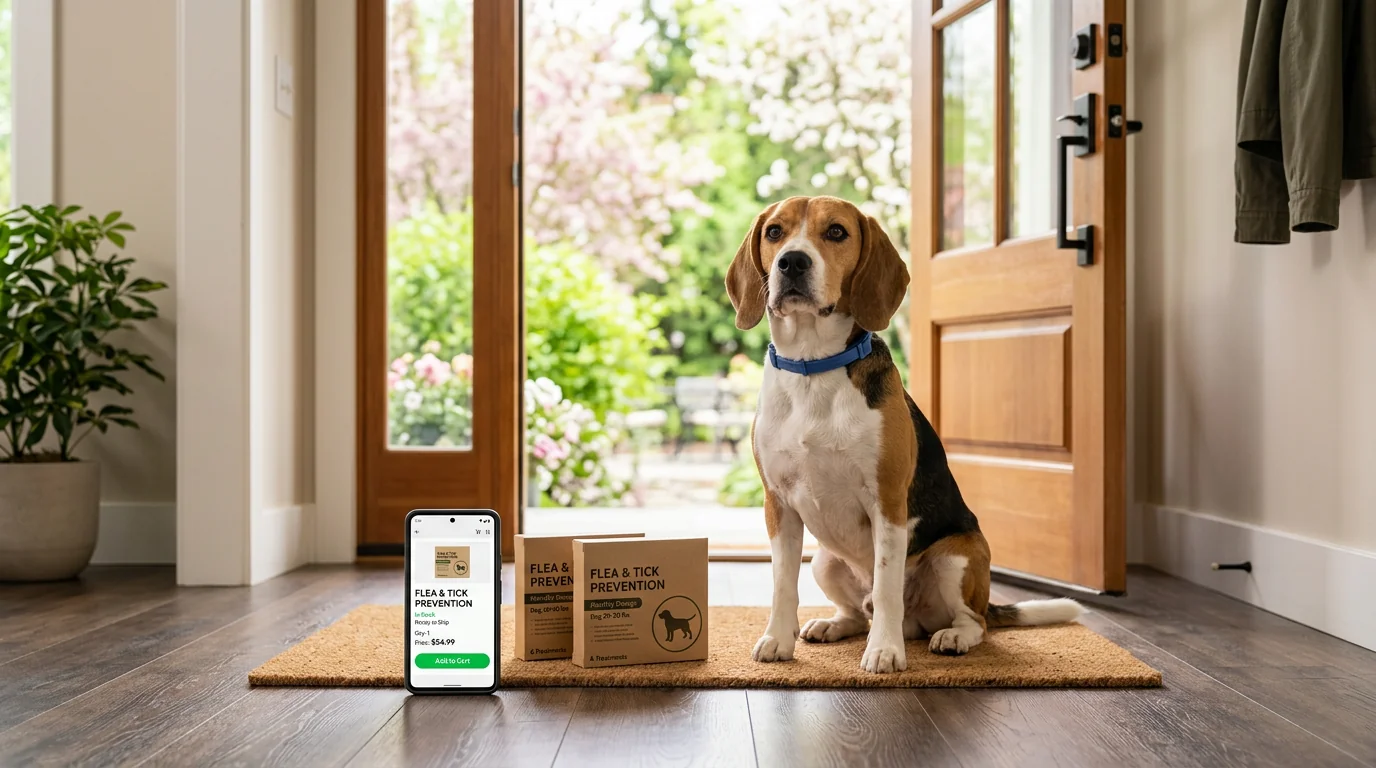
Scenario focus: aligning flea/tick season with in-stock preventatives
Inputs your system needs: demand signals, inventory, and margins
Blend search trends, weather anomalies, retailer calendars, and historical conversion data. Add live stock by variant, lead times, and margin tiers. This mix guides topic timing, product pairing, and promotional angles for pet ecommerce content strategy.
Outputs that matter: publish order, anchors, and product mapping
Produce a prioritized publish sequence, clear anchor text for buying intent, and deterministic product mapping. Map posts to PDPs with structured data and upsell modules. Support conversions with PDP best practices from product page optimization that converts.
Quick decision guide
If demand is rising but inventory is thin
Shift to educational posts that build intent without hard product commitments. Emphasize care guides and comparison frameworks. Add waitlist CTAs and restock alerts. Preserve rankings while protecting conversion expectations and merchandising flexibility.
If inventory is deep but search interest is flat
Prime demand using evergreen refreshes and lightweight social snippets. Schedule posts for peak engagement windows to lift discovery, as timing often influences interaction outcomes in digital channels.[1]
If competitor content surges on a seasonal topic
Publish counter-programming within 48-72 hours. Target related long-tail terms, differentiating with dosage charts, travel tips, or breed-size nuances. Reinforce with internal links using patterns from internal linking blueprints for pet eCommerce.
If margins vary across similar SKUs
Rerank briefs and internal anchors to highlight higher-margin variants. Maintain user benefit parity to avoid bias. Employ guardrails that cap low-margin exposure and redirect editorial focus when profitability crosses your minimum threshold.
If shipping cutoffs are approaching
Front-load posts for regions with longer delivery windows. Add urgency modules and precise cutoff dates. Adjust CTAs to local pickup or expedited services when feasible. Reduce post-cutoff spend and pivot to education and accessories.
If historical posts still rank but feature OOS SKUs
Hotfix anchors to substitutes, then reoptimize the on-page sections within 24-48 hours. Add an availability disclaimer. Monitor bounce and add-to-cart deltas. This may maintain continuity while safeguarding engagement quality.
If weather anomalies shift the season early/late
Advance or delay your weekly slots by one to two weeks. Adapt headlines to reflect timing changes. Use regional clusters to tailor cadence, especially for climates with distinct onset patterns across markets.
How to implement an automated, SKU-aware seasonal calendar
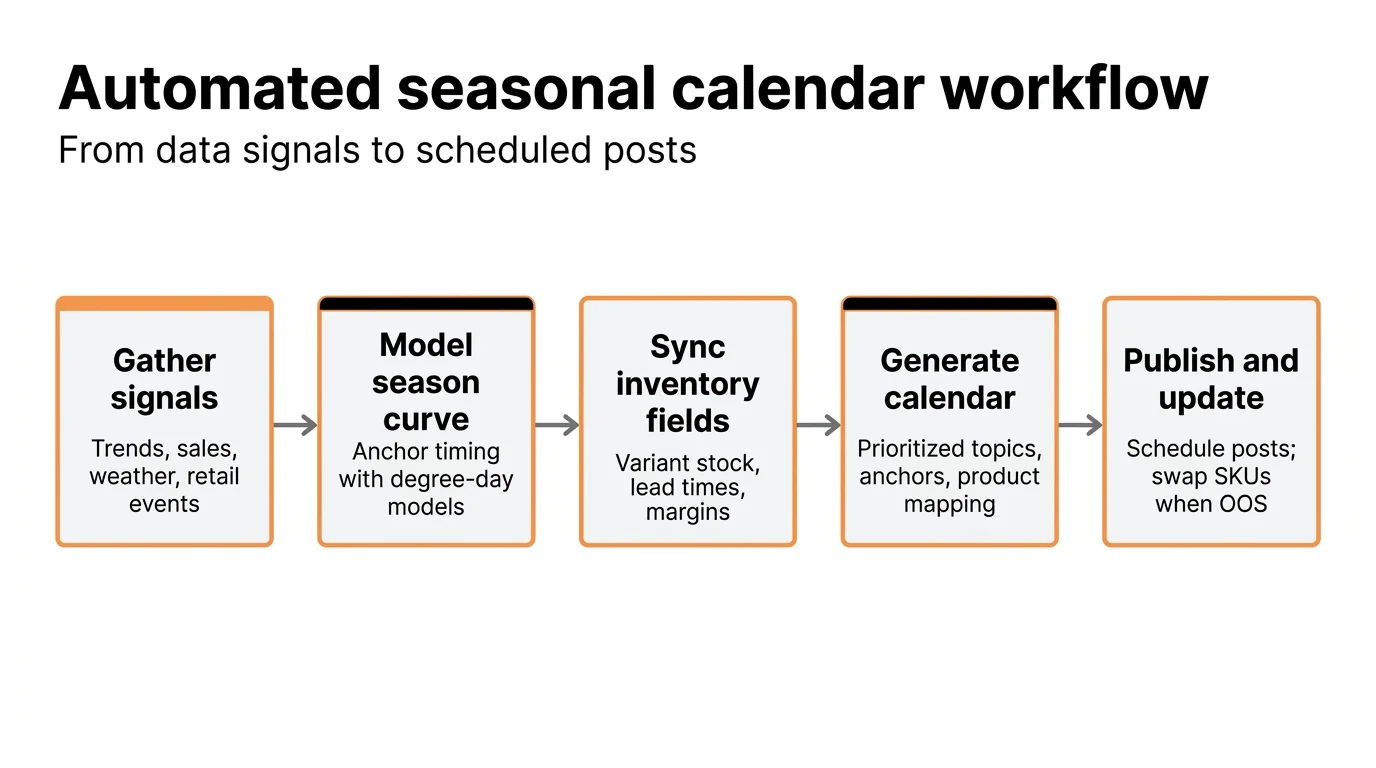
Map data: search trends, weather, and retail calendars
Pull Google Trends, historical sales, and degree-day weather models. Overlay retail events and paydays. This foundation anchors the season curve, enabling precise slots and angles that align with intent windows and buyer readiness.
Connect catalog data: stock, variants, and price/margin
Sync inventory by variant, include safety stock and lead times, and tag margin bands. The calendar references these fields to elevate profitable, stable SKUs and suppress fragile items. This is core to SKU-aware content calendar logic.
Automate briefs: keywords, angles, and internal links
Generate briefs with target keywords, reader outcomes, and compliant CTAs. Propose product pairings and link clusters using a topical explorer and authority builder. For practical orchestration, consider Petbase AI to draft season-aligned posts mapped to current inventory.
Schedule cadence: weekly slots tied to season curve
Set weekly or twice-weekly posts four to eight weeks before peak. Adjust publish times to audience behavior, as scheduling that matches user attention may elevate engagement outcomes across channels.[1]
Guardrails: de-prioritize OOS and low-margin items
Set rules to pause or soft-remove SKUs below thresholds, or with unstable supply. Push bundles and cross-sells when standalones are constrained. Align on-page modules with schema and PDP standards referenced in product page optimization.
Monitoring: what to check after 7-14 days and 4-8 weeks
7-14 days: indexing, rank movement, and stock sync health
Confirm indexing, top-20 rank glide, and crawl of updated anchors. Reconcile SKU stock, variants, and substitution logs. Early automation diagnostics benefit from AI schedulers that operationalize timing and routing efficiently.[2] Plan multi-language content creation if regional seasons diverge.
4-8 weeks: revenue attribution and seasonality fit
Evaluate assisted revenue per post, add-to-cart rate, and stockout correlation. Compare the publish curve to weather and search trend curves. If lagging, pull the calendar forward; if overshooting, compress cadence or pivot to education.
Practical safety boundaries
Medical and regulatory language for parasite prevention
Avoid claims that imply diagnosis, guaranteed outcomes, or off-label use. Cite general education, not medical advice. Provide disclaimers and encourage veterinary consultation. Maintain consistent editorial review for compliance across seasonal prevention content.
Out-of-stock and substitution logic
Trigger substitutions only for near-equivalent SKUs, with clear labeling. Cap substitution chain length to avoid confusion. Revisit original anchors post-restock. Use SEO optimization/rewrites for existing product and blog pages to refresh copy and links responsibly.
Coupon and price claims governance
Expire coupons automatically and timestamp price references. Prefer “from” pricing and avoid implied perpetual discounts. Route legal review for promotional language during peak season, when changes and scrutiny intensify.
Evidence status and what the data suggests
Seasonal alignment may support higher CTR and conversion
Timing content to audience attention often improves engagement in digital environments, suggesting aligned cadence can lift CTR and downstream conversion during peaks, especially when windows are brief.[1]
SKU-aware internal links may reduce bounce on OOS pages
Automation in news and media demonstrates that AI can route content efficiently under constraints, supporting responsive linking and updates when availability shifts.[3] Practical AI schedulers also reduce manual lag in execution.[2]
Consistent cadence may correlate with topical authority growth
Optimization frameworks show that scheduling under constraints increases throughput while minimizing conflicts, a useful analog for steady publishing with competing SKUs and priorities.[4]
Measurement blueprint for SKU-season alignment
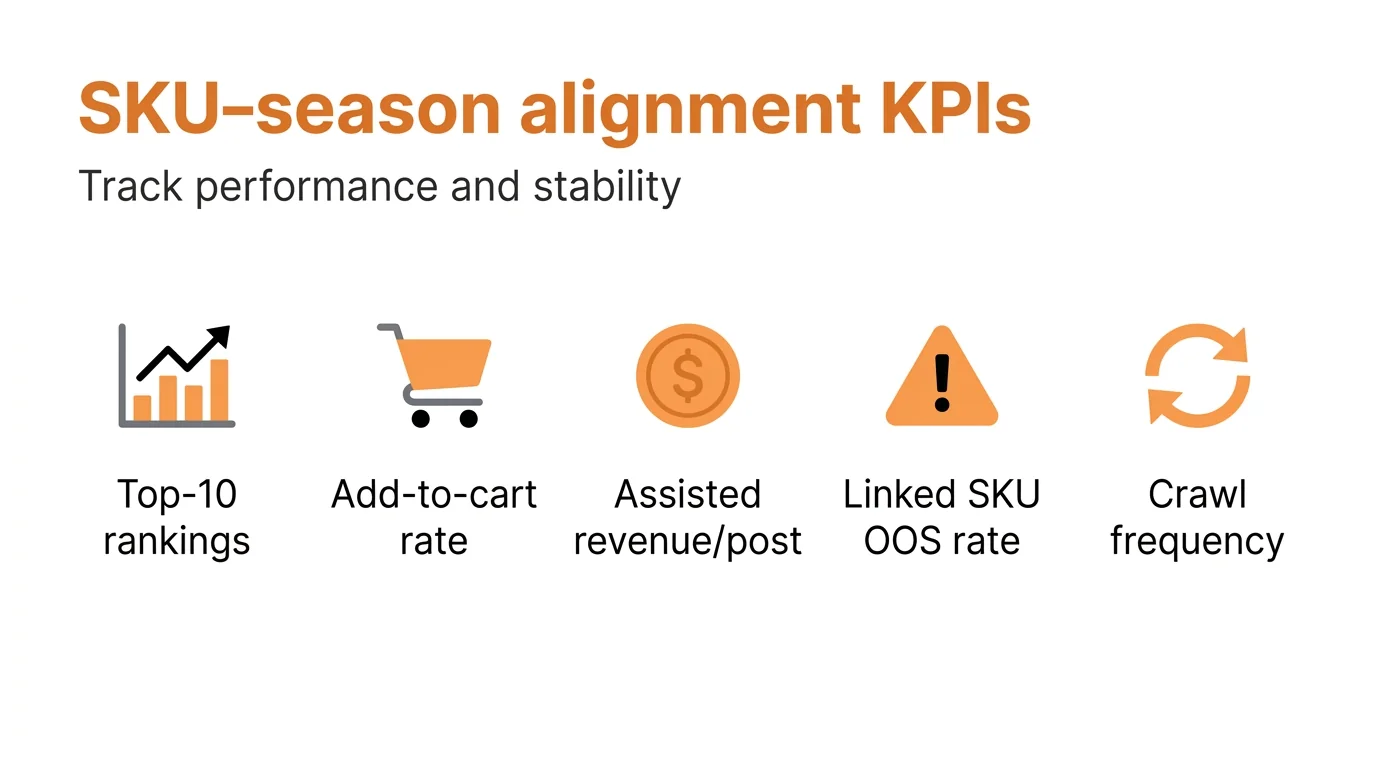
Core KPIs: ranked posts, add-to-carts, revenue per post
Track unique posts ranking in top-10, add-to-cart rate by mapped SKU, assisted and last-click revenue per post, and time-to-index. Use assisted revenue guidance from measurement beyond rankings to contextualize impacts.
Diagnostic metrics: OOS rate, substitution rate, refund flags
Monitor OOS rate on linked SKUs, substitution acceptance rate, refund flags tied to misleading claims, and crawl frequency of updated anchors. Rising OOS with flat traffic indicates calendar-inventory mismatch requiring reprioritization.
Frequently Asked Questions
How do I make an editorial calendar react to inventory changes?
Connect your CMS to inventory data and apply rules that pause or swap posts when SKUs fall below a stock threshold. Evidence suggests this may protect conversion and user trust.
Which signals should drive seasonal pet content?
Blend search trends, historical sales, weather patterns, and retail holidays. This mix may help time topics like fleas, shedding, and travel more accurately.
What if my top seasonal product goes out of stock?
Use substitution logic to link to close alternatives and update anchors. Re-optimize the article within 24-48 hours to minimize lost demand.
How often should I publish during peak season?
A weekly cadence for 4-8 weeks leading into the peak may be effective, with refreshes as rankings and stock change. Adjust frequency based on indexation and inventory depth.
Can automated calendars work for multi-brand catalogs?
Yes, if your rules consider margins, brand priorities, and compliance notes. Routing by category and life stage may improve matching between posts and SKUs.
Conclusion and next steps
Tie the flea/tick scenario back to brand-wide AI visibility
Automating seasonal cadence and SKU mapping protects momentum when markets shift. This focused flea/tick framework scales to shedding, travel, and allergy spikes. It becomes a repeatable engine that supports pet SEO automation and profitable execution.
View the AI Visibility orientation hub
Extend this playbook into internal linking, schema, and multilingual rollouts. Explore adjacent blueprints in multilingual rollouts with clean indexation, and revisit priorities via a rapid AI SEO gap audit. View the AI Visibility orientation hub to unify these motions.
References
- VK Kanuri et al. (2018). Scheduling content on social media: Theory, evidence, and application. Journal of Marketing. View article
- S Alangaram et al. (2026). Socialflow AI: Voice to social media scheduler. International Journal of …. View article
- MF de-Lima-Santos et al. (2021). Artificial intelligence in news media: Current perceptions and future outlook. Journalism and media. View article
- M Zhong et al. (2020). Multi-AGV scheduling for conflict-free path planning in automated container terminals. Computers & Industrial …. View article